What's New in VMware Cloud Foundation 9.1: Complete Feature Overview and Architecture
Everything new in VMware Cloud Foundation 9.1, from memory tiering and security enhancements to lifecycle management and private AI infrastructure. A complete feature-by-feature architecture overview.

As someone who has spent years navigating the complexities of SDDC lifecycle management and architectural trade-offs, I’ve seen many incremental updates. However, VMware Cloud Foundation (VCF) 9.1 is different. It represents a fundamental shift in how the hyperconverged control plane operates, scales, and recovers.
This release isn't a feature bump; it's a structural overhaul moving away from discrete legacy virtual appliances toward a unified, containerized services runtime.
Executive Summary: VCF 9.1 deprecates discrete management VMs in favor of a containerized microservices architecture. Financial and risk impacts include eliminating storage silos via native vSAN S3, increasing host consolidation up to 40% via NVMe memory tiering, and structurally reducing control-plane upgrade downtime by shifting to a centralized software depot.
The Business Impact: Why Execs and IT Teams Should Care
Before diving into the engineering mechanics, we must translate these architectural shifts into business outcomes. VCF 9.1 alters the risk profile and cost structure of the private cloud:
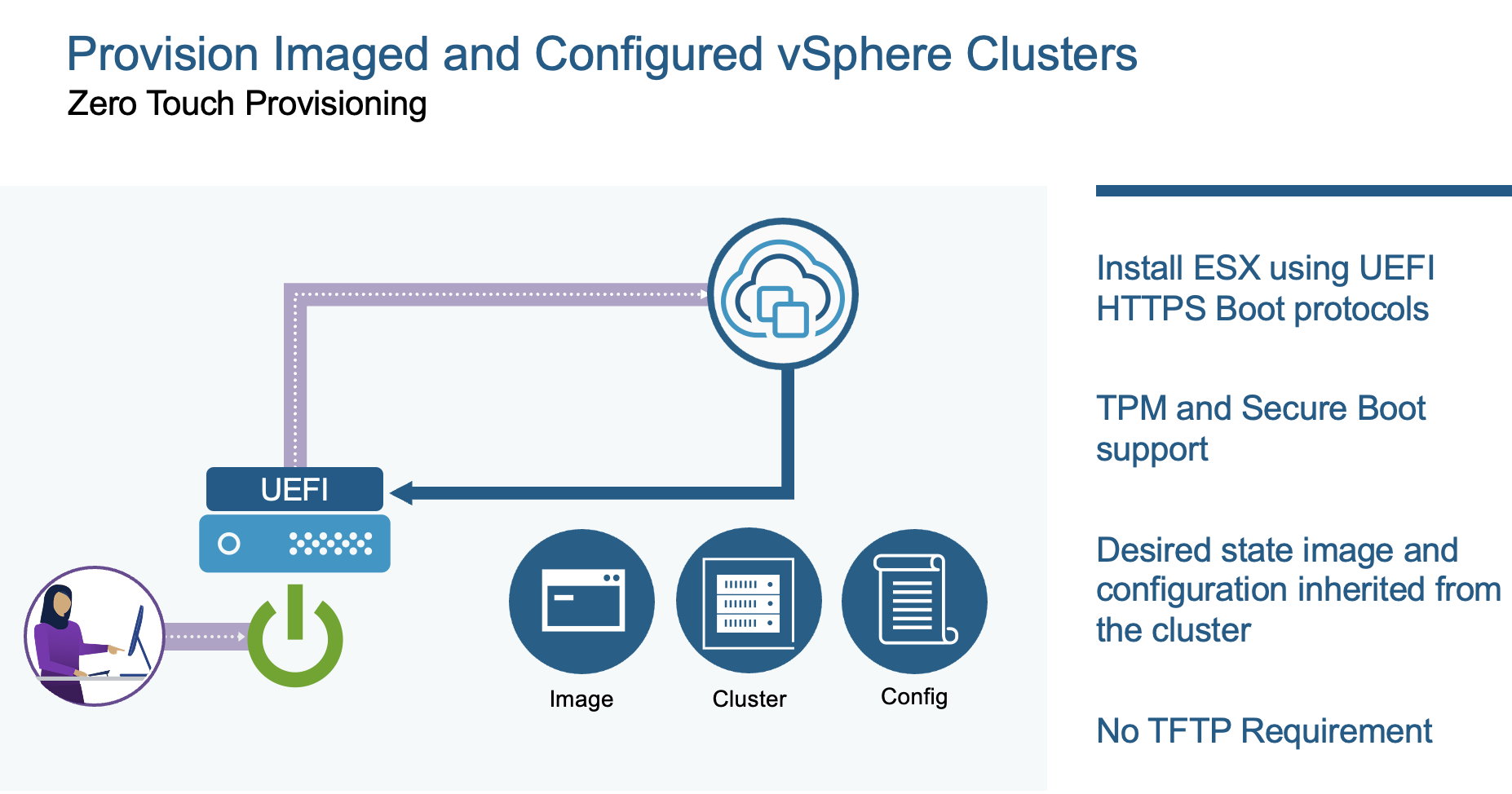
- Accelerated Time-to-Market: The shift to Zero-Touch Provisioning (ZTP) and API-driven scaling means deploying new clusters or expanding capacity drops from days of manual configuration to hours of automated workflows.
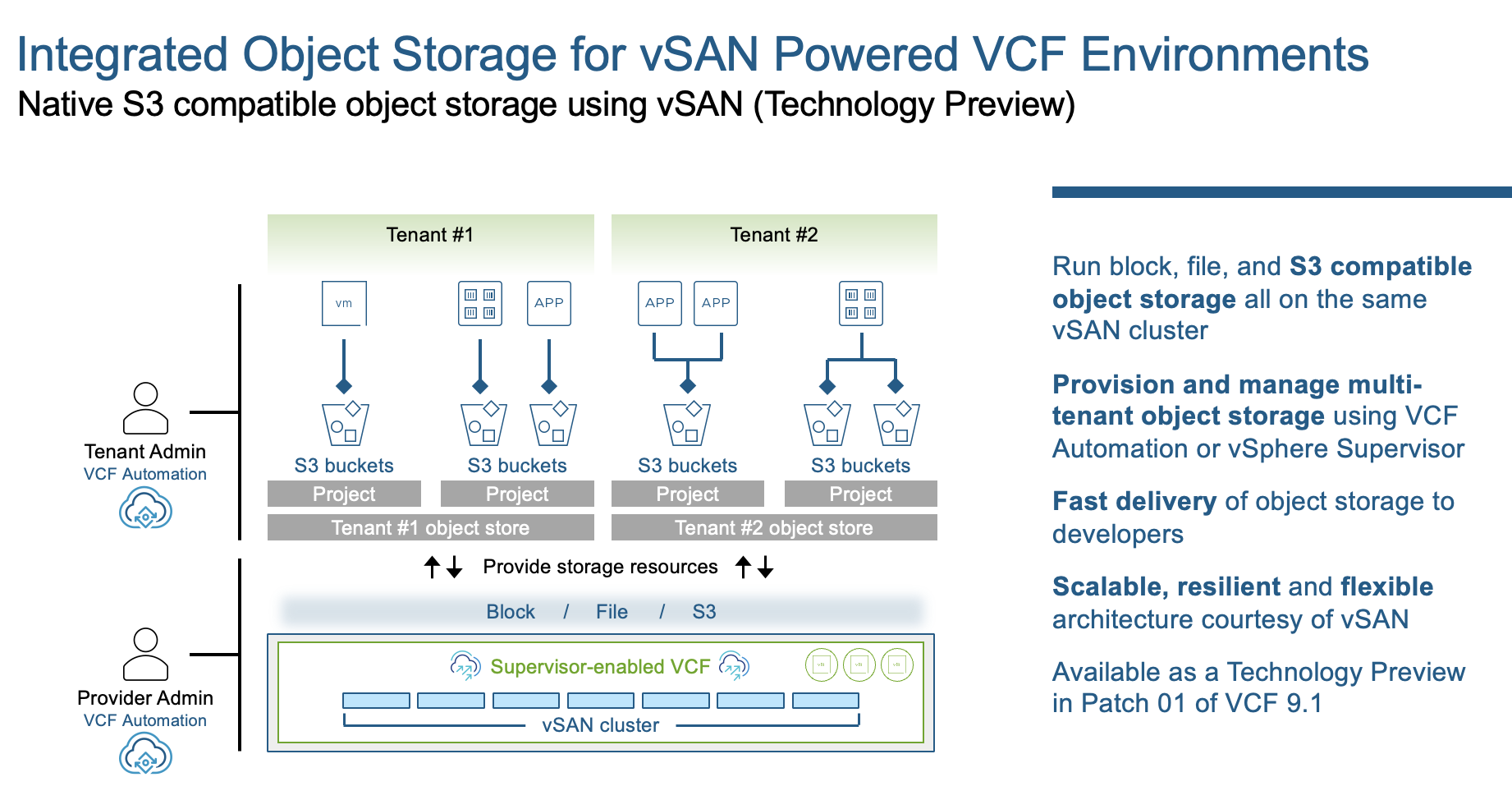
- Drastic Storage Cost Reduction: Introducing native S3 object storage directly into vSAN allows organizations to retire costly, siloed third-party object storage arrays. Combined with NVMe memory tiering and the new zStandard compression, hardware consolidation ratios improve significantly.
- Operational Resilience: Deprecating discrete management VMs in favor of a containerized runtime eliminates the "split-brain" failures of the past. Patching and upgrades are faster and safer, requiring fewer maintenance windows and directly reducing operational risk.
VCF 9.1 Core Platform Enhancements
The architectural delta between 5.x/9.0 and 9.1 forces immediate updates to operational runbooks across compute, storage, and networking domains.
Compute and vSphere Upgrades
- Zero-Touch Provisioning (ZTP) via UEFI HTTP/S: The reliance on external TFTP servers for vSphere Auto-Deploy is eliminated. ZTP now uses native UEFI HTTP/S Boot, enforcing Secure Boot and TPM attestation at the hardware boundary. Failure Mode Mitigation: Network topologies must ensure DHCP options (Vendor Class Identifier) correctly route HTTP/S boot requests to the VCF software depot. Misconfigurations will cause bare-metal bootstrapping to halt with generic UEFI timeouts, requiring packet-level debugging to trace the DHCP payload.
- Reduced Downtime Upgrades (RDU) and Control Plane Scaling: vCenter upgrades now support an online depot connectivity method. Furthermore, VCF 9.1 exposes a single API endpoint to dynamically resize vCenter compute resources, bypassing manual vApp property modifications and sequential reboots.
- NVMe Memory Tiering: Configuration profiles now support claiming NVMe devices as a distinct memory tier. This offloads inactive memory pages to high-speed NVMe, freeing DDR for active working sets and increasing host consolidation ratios by up to 40%.
- API and Backup Safeguards: Heavy VADP snapshot and backup operations now operate on dedicated thread pools. They no longer monopolize the vCenter
vpxdservice, preventing API timeouts during high-concurrency backup windows.
vSAN 9.1 and Data Persistence
- Native S3 Object Storage: vSAN 9.1 introduces multi-tenant S3-compatible object storage natively. VCF Automation orchestrates bucket and service creation per organization, mapping logical S3 boundaries to underlying vSAN capacity.
- Compression Algorithm Swap (zStandard): The underlying compression algorithm shifts from LZ4 to zStandard. While it consumes slightly more CPU cycles during aggressive writes, it yields superior compression ratios over time, directly impacting storage TCO at the cost of quantifiable compute overhead.
- Auto-RAID Policy Engine: Storage policies can now dynamically adjust RAID levels based on cluster scale. This prevents object rebuild failures if a cluster drops below the required node count, ensuring availability without administrative intervention.
- Cyber Recovery & QLC Support: The platform introduces "Any to vSAN ESA" replication and explicit support for high-capacity QLC NAND, ideal for clean-room recovery topologies.
The Management Services Delta: From Monoliths to Microservices
The most profound architectural transition in VCF 9.1 is the deprecation of discrete management appliances in favor of the VCF Management Services architecture.
Old State: Discrete Legacy Appliances
Historically, VCF relied on isolated monolithic VMs:
- VMware Aria Suite Lifecycle handled operations and automation deployments.
- Workspace ONE Access managed federated identity.
- VMware Aria Operations for Logs required dedicated clustering.
- SDDC Manager operated as a standalone orchestrator.
Failure Modes of the Old State: This fragmented architecture induced high operational cognitive load. Certificate rotation and patch sequencing required orchestrated synchronization across multiple operating systems. Split-brain conditions during network partitions often resulted in corrupted state files.
New State: Unified VCF Services Runtime
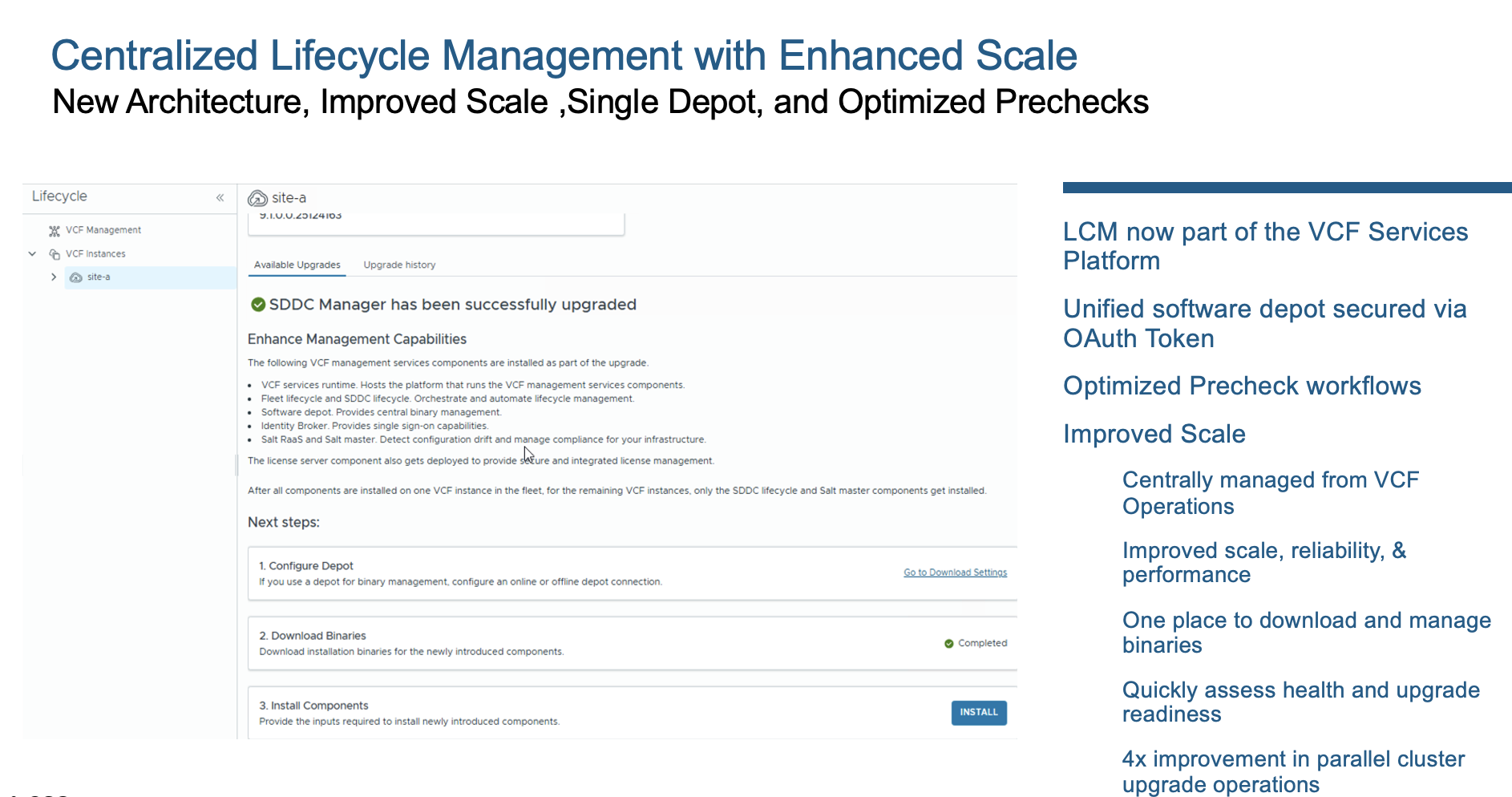
VCF 9.1 instantiates an internal container framework called the VCF services runtime. Components are decoupled into fleet-level and instance-level microservices.
- Fleet Lifecycle & SDDC Lifecycle: Completely replaces VMware Aria Suite Lifecycle. Fleet lifecycle coordinates upgrade sequencing across multiple instances, while SDDC lifecycle executes localized patching.
- Identity Broker: Replaces Workspace ONE Access, acting as the centralized SSO and SAML/OIDC federation endpoint.
- Log Management: Replaces Aria Operations for Logs, shifting intelligent log analysis into a modular service integrated within the VCF Operations domain.
- Software Depot: A centralized internal store for binaries and OCI images, secured natively via OAuth tokens.
- Salt Master & Salt RaaS: Introduces native desired-state enforcement and policy configuration for VCF components.
Migration Path Clarity and Convergence Gotchas
Upgrading from 5.x or 9.0 is not an in-place binary swap. It requires converging the standalone Aria components into the unified VCF services runtime.
- The Dependency Sequence: You cannot patch nodes out of order. Fleet management deploys first, followed by vCenter, NSX, and finally ESXi hosts.
- Downtime Expectations: During the cutover to the new runtime, the control plane experiences temporary API unavailability. However, data plane routing, workload execution, and NSX East-West traffic remain entirely untouched.
- IdP Federation Cutover: Migrating from Workspace ONE Access to the new Identity Broker requires careful repointing of existing SAML/OIDC trusts. Failure to map claims correctly during this window will lock out fleet administrators.
Operational Runbook Updates
Engineering teams must rewrite Day-2 operational runbooks to accommodate the new architecture. Start with these three areas:
- Backup and Restore: Stop executing VM-level VADP snapshots for Aria components. Backups must now target the unified VCF services runtime APIs to capture the container state losslessly.
- Log Aggregation: Redirect third-party syslog forwarders. They must point away from legacy Aria Ops for Logs VIPs and toward the new Log Management microservice endpoints.
- Lifecycle Orchestration: Any custom CI/CD pipelines calling Aria Lifecycle Manager APIs will break. Refactor these pipelines to authenticate and push payloads to the new Fleet Lifecycle API endpoints.
Configuration API Example: FIPS Verification
With the monolithic approach deprecated, API calls interact directly with the unified endpoint. For example, querying the FIPS 140-2 compliance status (which is strictly enforced in 9.1) across the fleet management components:
# Querying FIPS compliance status across the VCF Management Services runtime
curl -X GET "https://<vcf-services-runtime-fqdn>/api/appliance/fips/status" \
     -H "Authorization: Bearer $OAUTH_TOKEN" \
     -H "Content-Type: application/json"

# Expected Output snippet
{
  "fips_mode_enabled": true,
  "enforcement_level": "STRICT",
  "affected_components": [
    "identity_broker",
    "fleet_lifecycle",
    "software_depot",
    "sddc_lifecycle"
  ]
}
This structural shift in 9.1 mandates that engineering teams abandon legacy VM-centric management models and adopt declarative, API-driven workflows to interact securely with the VCF control plane.
References & Source Material
This is just a glimpse of what’s new in VCF 9.1. There are many more improvements I’ll be covering soon.
Related Reading
Discussion
No comments yet. Be the first to start the discussion.
Related Articles
VCF 9.1.1: A Leaner Management Footprint and How to Plan for It
VCF 9.1.1 introduces optimized VCFMS worker sizing, Small HA deployments, and vDefend SSP 5.2 two-node form factor. Here is what changed, what the numbers look like, and how the Planning Workbook helps you size it all before Day 0.
VMwareBroadcom's Gartner Double Crown: What Two Magic Quadrant Leader Positions Mean for VCF Architects
Broadcom earned the Leader position in both the 2026 Gartner Magic Quadrant for Distributed Hybrid Infrastructure and Server Virtualization Platforms, with Gartner noting the acquisition has 'reinvigorated' the market. Here is what that means for architects making platform decisions.
VMwareVMware AI Factory: GPU Pooling, AI Tokenomics, and What VCF Customers Should Do Now
Broadcom shipped VMware AI Factory at Explore 2026. The technology is solid. Here is what it actually means for your infrastructure, your GPU costs, and your agentic AI deployments.
Stay in the loop
Get new articles on infrastructure and AI delivered to your inbox. No spam, unsubscribe anytime.