The Agentic Shift: How AI Agents Are Changing IT Operations and Management
AI agents are moving from executing tasks to orchestrating entire workflows. What this means for IT managers, operations teams, and the future of infrastructure management.

The software development market, and consequently the entire knowledge economy, is experiencing a fundamental structural realignment. Anthropic’s 2026 Agentic Coding Trends Report provides a clear roadmap of eight foundational trends, proving that the era of the reactive "chatbot" has effectively ended. We are in the midst of an accelerated transition toward distributed, autonomous multi-agent systems: a shift that is redefining the operational and business boundaries of the industry.
The Interface Evolution: From Chatbots to Multi-Agent Ecosystems
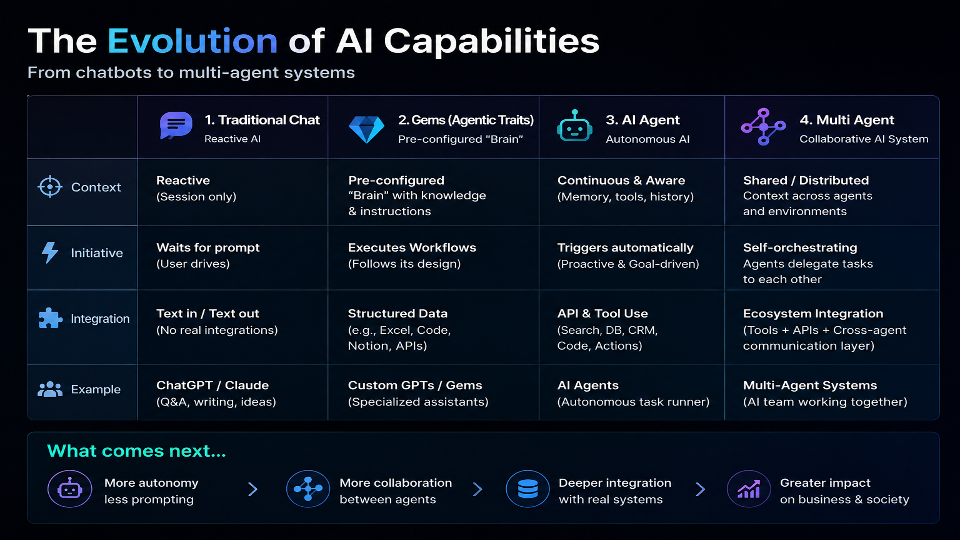
Anthropic's report presents empirical data on how work architecture and technological integration have evolved across four major stages:
- Reactive Chat: Single-prompt interactions where the model generates highly localized code within a short-lived context window. This stage was characterized by severe memory limitations and hallucinations whenever token overhead increased.
- Custom Assistants and Gems: The introduction of persistent system instructions and ongoing context. The model understands writing style and system boundaries but still requires a tight, continuous human feedback loop for every action.
- Autonomous Agents: The leap to end-to-end complex task execution. The agent can independently read files, run tests, and fix compilation errors over hours of work, executing system tools (CLI) without continuous human intervention.
- Multi-Agent Ecosystems: The most modern architecture, where a problem is decomposed into sub-tasks and distributed among specialized parallel agents. A frontend agent manages application state, a database agent handles migrations, and a security agent analyzes the diffs, all coordinated seamlessly by an Orchestrator agent sharing state and context transparently.
The data reveals a fascinating reality: professionals currently integrate AI tools into roughly 60% of their workflows, yet they are able to fully delegate tasks only 20% of the time. This "delegation gap" does not stem from code generation speed, but rather from the human difficulty in decomposing complex problems and resolving architectural ambiguity.
The New Paradigm: We Are All Becoming Managers
As technological capabilities allow agents to operate autonomously, the operational model of the worker changes entirely. The cognitive load is uprooted from manual execution (writing syntax, entering data, or debugging) and migrates to defining intent, managing risk, and establishing legal and business boundaries.
This shift forces a transition from being "executors" to becoming "managers." The modern worker is no longer required to maintain the muscle memory of writing code or performing monotonous tasks; instead, they are required to manage a fleet of specialized digital agents, allocate resources, define objectives, and audit their outputs.
Breaking the Syntax Barrier: Evidence from the Trenches
This architectural pivot is not merely theoretical; it is vividly reflected in my own personal experience. With academic and practical backgrounds in business and law, alongside advanced certifications in IT infrastructure, cybersecurity, and networking, I have always known how to manage complex projects, whether designing a network architecture or overseeing a real estate renovation from the foundation to the final finishes. I deeply understood logic, structural integrity, and risk management. However, I lacked the physical ability to write programming syntax, which created a hard barrier between me and independent app development, leaving me entirely dependent on external engineers.
Working with Claude Code, Gemini CLI, Codex and others shattered that ceiling completely. The system allowed me to bypass the implementation details and syntactic complexities of development. I am no longer required to write code to build an application; my role is to manage the process. My deep knowledge of infrastructure and project management translates directly into precise instructions for the agent, which handles the development, resolves networking issues, and connects the system components exactly as I architected them.
The Return to Bare Metal: Why Agents Don't Need GUIs
This agentic shift also reveals a fascinating technical paradox: as human operators move up the stack to orchestration, our AI agents are moving down the stack, closer to the bare metal. Programming languages and frameworks that seemed to be losing the spotlight to flashy frontend interfaces are making a massive resurgence.
Take data processing, for example. Historically, analyzing a massive dataset meant booting up Microsoft Excel: a heavy, bloated application burdened by loading a Graphical User Interface (GUI), grid lines, cell colors, and macro settings designed for human eyes. Autonomous agents do not need UI/UX. When I instruct my agent to process a 300,000-row CSV file, it bypasses the spreadsheet entirely. Instead, it writes a Python script utilizing a data science library called Pandas.
This is the secret to the speed. Pandas is written primarily in C: one of the oldest and fastest programming languages in the world. It reads the raw text directly into the server's RAM in a fraction of a second. The agent doesn't care what the data looks like; it only cares about the raw values and the computational efficiency. The lower-level languages haven't disappeared; they have simply stopped serving human end-users and have become the invisible, high-performance engines powering the autonomous economy.
The Skills Arbitrage: Risk vs. Opportunity
This phenomenon exposes a fundamental macroeconomic truth: where an existential risk emerges for one group of professionals, a historic opportunity is born for another.
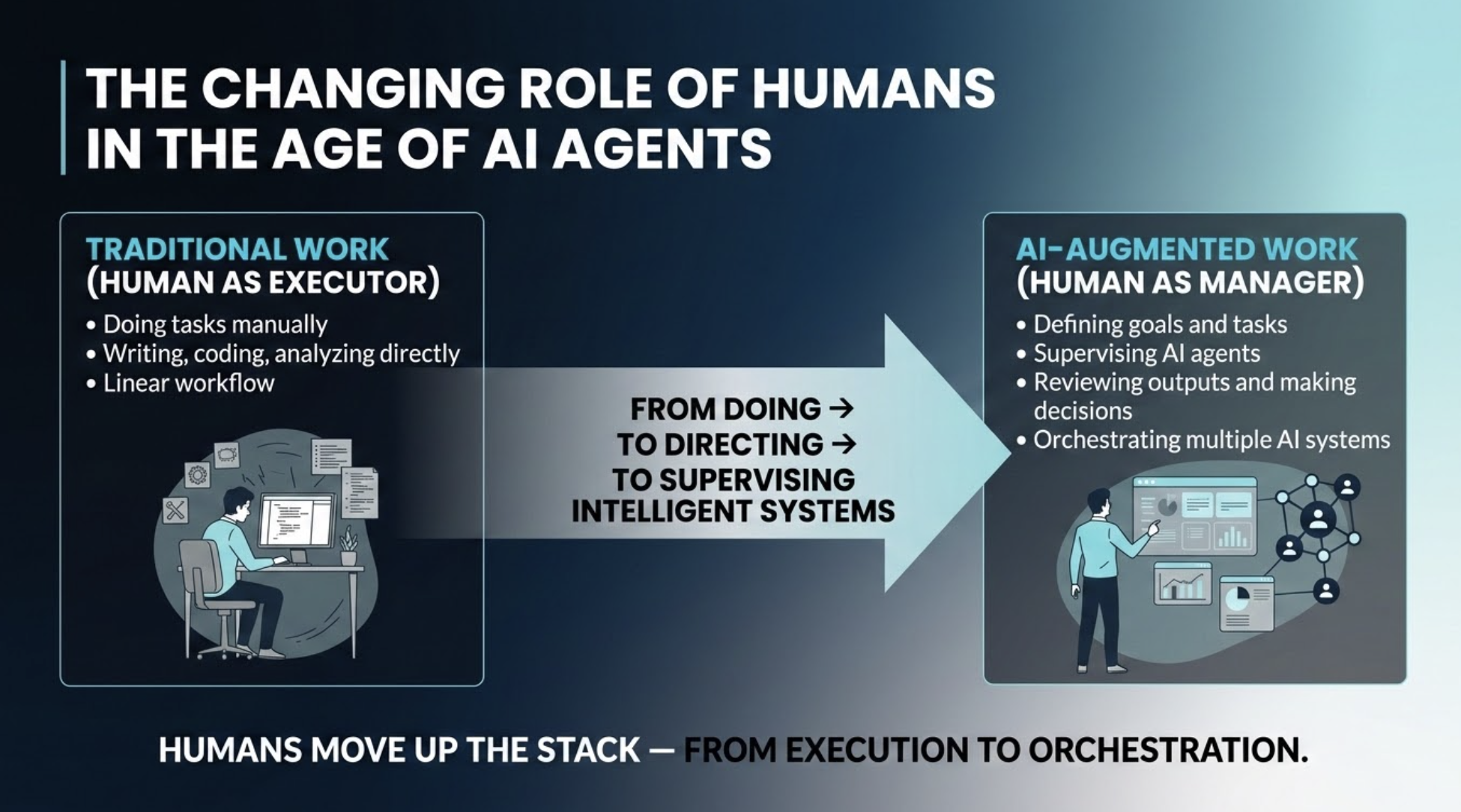
The devaluation of manual execution poses a tangible threat to those whose primary value is reduced to typing lines of code or blindly executing technical tasks. Conversely, this shift provides massive leverage to polymaths, multi-disciplinary experts, and managers who can see the big picture. These new tools transfer the means of production into the hands of those who understand strategy, process orchestration, and aesthetic design. The decisive skill in 2026 is no longer obedience to the grammatical rules of a programming language, but the ability to precisely isolate the objective, construct the correct mental model, and lead digital agents to execute a flawless build, from the foundation to the finishes.
Resources:
Related Reading
Discussion
No comments yet. Be the first to start the discussion.
Stay in the loop
Get new articles on infrastructure and AI delivered to your inbox. No spam, unsubscribe anytime.