Tesla Chose Grok. BMW Chose Alexa. Mercedes Chose ChatGPT. The AI War Has Moved to Your Dashboard.
Every major automaker just picked an AI side. Tesla went with Grok, BMW chose Alexa+, Mercedes bet on ChatGPT, and Renault and GM brought in Gemini. Your car already has a large language model in it. Here is what that means.
Every major automaker just picked a side. Tesla went with Grok. BMW chose Alexa. Renault and GM brought in Gemini. Mercedes bet on ChatGPT. Volkswagen did the same. And just like that, your car became the next front in the AI platform war.
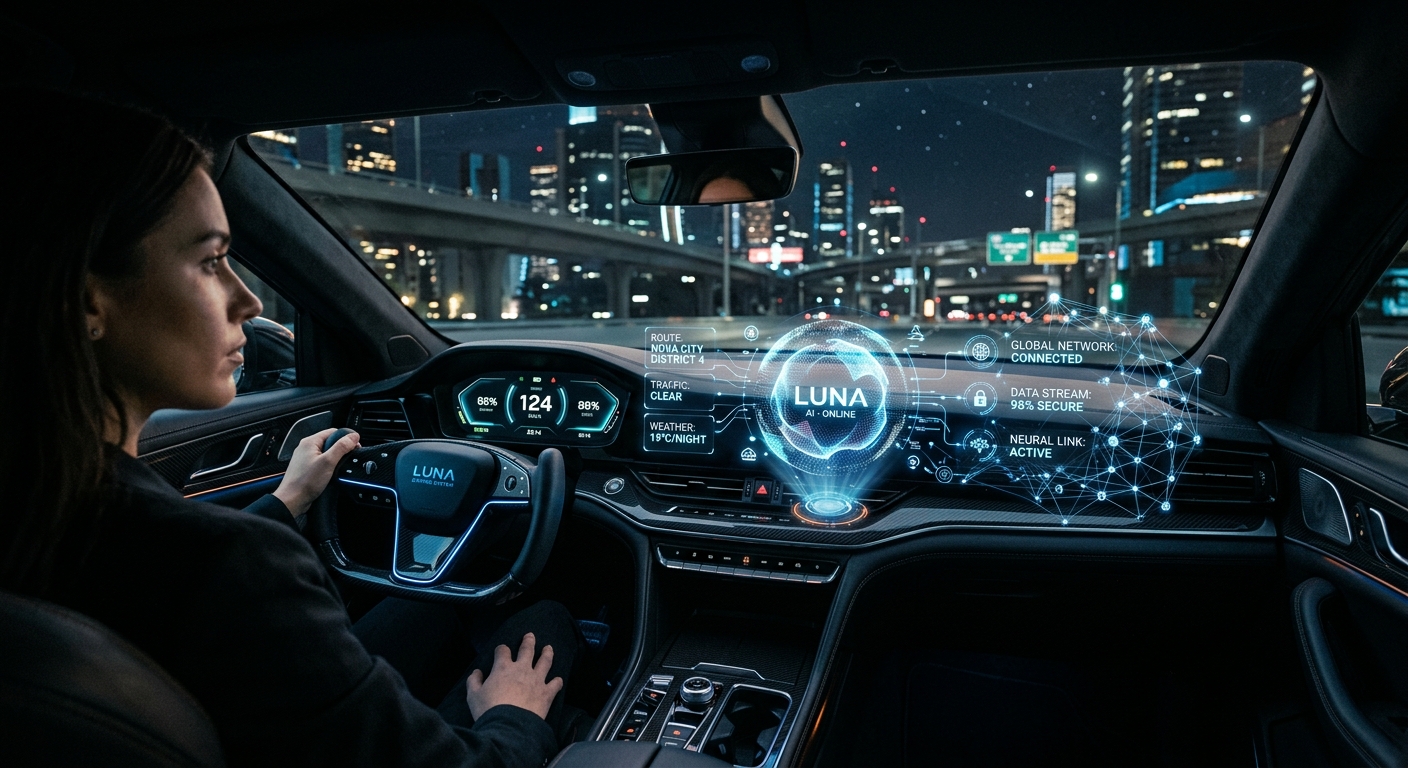
This is not about self-driving. That story has been playing out for years. This is about something different, something that happened almost overnight in 2026: the world's biggest car manufacturers started embedding large language models directly into their vehicles. Not simple voice commands. Not "turn left in 200 meters." Full conversational AI that understands context, remembers what you said three minutes ago, and controls dozens of vehicle functions by voice.
The car is no longer just a car. It is becoming an AI device you happen to drive.
Tesla and Grok: The In-House Play
Tesla's approach is the most aggressive. With the Spring 2026 update, Tesla introduced "Hey Grok," a wake-word activated assistant powered by xAI's Grok model. The system runs on Grok Voice Think Fast 2.0 and processes speech in 0.7 seconds, even at highway speeds.
The numbers tell the story. Grok now controls 116 out of 170 tested car functions: climate, seat heaters, mirrors, wipers, glovebox, Dog Mode, Camp Mode, Sentry Mode, Supercharger routing, and Dashcam clips. It is the only system that comes from the same corporate ecosystem as the car itself, since Elon Musk owns both Tesla and xAI.
But there is a catch. Only Teslas with the AMD Ryzen chip (2021 refresh and newer) can run it. Older Intel Atom-based cars are locked out permanently. And with a 68% success rate across all tested functions, Tesla's own documentation positions Grok as reliable enough for convenience, not for driving decisions.
BMW and Alexa+: The Smart Home Bridge
BMW took a different route. At CES 2026, BMW became the first automaker to integrate Amazon's Alexa+ architecture into its vehicles. The system debuts in the 2026 iX3 and will expand across all models running Operating System 9 in the second half of 2026.
The pitch is natural conversation. Instead of memorized commands, you speak to the car the way you would speak to a person. Ask about a painting, then say "take me there," and the system connects the dots.
What makes the BMW approach distinct is the ecosystem play. Alexa+ connects to Amazon's smart home infrastructure, music library, and commerce platform. Your car becomes an extension of your living room. Whether that is a feature or a privacy concern depends on your perspective.
Renault and Gemini: The Mass Market Move
Renault made the most democratic move. Starting June 15, 2026, Google Gemini rolled out as a free over-the-air update to every Renault vehicle equipped with openR link, from the Twingo to the Rafale. No dealer visit. No subscription. Just an update.
Gemini in Renault handles climate, navigation, radio, and settings through natural conversation. Say "it's cold in here" and the system adjusts the temperature. Ask it to route to Paris but avoid the ring road, and it figures out the rest. It supports 13 languages and can switch between them mid-conversation through Gemini Live.
The significance here is scale. Renault is not a luxury brand. This is AI reaching the mass market, going into cars that regular families drive every day.
GM and Gemini: Four Million Cars Overnight
GM went even bigger. In April 2026, Google Gemini started rolling out to approximately 4 million eligible vehicles in the US, covering model year 2022 and newer Cadillac, Chevrolet, Buick, and GMC models.
The integration goes beyond basic voice commands. Gemini in GM vehicles can summarize incoming texts, draft responses, translate messages, create contextual playlists based on drive duration, plan multi-stop routes, and even help commercial drivers optimize for fuel efficiency. All through natural conversation.
GM has signaled this is just the beginning. A deeper, custom-built AI experience is planned for later in 2026.
Mercedes and ChatGPT: Three Million Vehicles
Mercedes-Benz rolled out its ChatGPT-powered MBUX Voice Assistant to over 3 million vehicles as a free update. Built on Microsoft Azure OpenAI Service with Bing integration for real-time data, the system supports context-aware follow-up conversations and retains conversation history for up to one hour.
Mercedes was actually ahead of the curve here. They launched the ChatGPT beta program before most competitors had even announced their AI partnerships. The "Hey Mercedes" activation has been controlling vehicle functions for years, and ChatGPT adds a knowledge layer on top.
Volkswagen: ChatGPT for the People's Car
Volkswagen integrated ChatGPT across most of its US lineup, making it one of the first volume manufacturers to bring generative AI into everyday vehicles. The system runs through the existing IDA voice assistant, adding conversational depth to what was previously a command-based interface.
The symbolic weight here matters. Volkswagen is literally "the people's car." When ChatGPT shows up in a Jetta, AI stops being a luxury feature and becomes standard equipment.
The Real Story: Platform Lock-In
Look at the pattern:
| Automaker | AI Platform | Scale |
|---|---|---|
| Tesla | Grok (xAI) | All AMD-equipped Teslas |
| BMW | Alexa+ (Amazon) | iX3, expanding to all OS9 models |
| Renault | Gemini (Google) | All openR link vehicles |
| GM | Gemini (Google) | ~4 million US vehicles |
| Mercedes | ChatGPT (OpenAI/Microsoft) | 3+ million vehicles |
| Volkswagen | ChatGPT (OpenAI) | Most US models |
| Kia | ChatGPT-based | EV3 and expanding |
This is not a coincidence. This is the smartphone wars all over again, except the stakes are higher because the platform is a two-ton machine moving at highway speed.
Every AI provider wants to be the default interface between you and your car. Once you are used to saying "Hey Grok" or "Hey Mercedes," switching costs become real. Your preferences, your conversation history, your connected services all live inside that ecosystem.
Google gets Renault and GM. Amazon gets BMW. OpenAI gets Mercedes and Volkswagen. xAI gets Tesla. The car companies get a better product. And you, the driver, get locked into whichever AI ecosystem your car manufacturer chose for you.
Where Does All That Compute Actually Run?
Every conversation with Grok, Gemini, or ChatGPT in your car is a round trip to the cloud. Tesla says it explicitly: the car is a thin client. Microphone in, streamed tokens out.
Now multiply that by the numbers in this article. Four million GM vehicles. Three million Mercedes. Every AMD-equipped Tesla. Millions of Renaults and Volkswagens. All sending inference requests to data centers, all day, every day.
That is an enormous amount of compute. And it is almost entirely inference, not training. The models are already built. What the cloud has to do, millions of times per second, is run those models against your voice input and return a response fast enough that you do not crash while waiting for an answer.
This is exactly why the economics of AI infrastructure are shifting. General-purpose GPUs are great for training models and for experimentation. But when you need to serve inference at this scale, at this cost, the math changes. Custom silicon designed specifically for inference workloads, optimized for cost-per-query rather than raw flexibility, becomes the only way to make the economics work. I wrote about this shift in detail in Beyond GPUs: How Broadcom Custom Silicon Is Reshaping AI Infrastructure, where the core argument is that inference is the dominant recurring cost in AI, and custom XPUs are how hyperscalers are solving it.
Your car conversation with Grok or Gemini feels like a simple feature. Behind it sits a global infrastructure race that is reshaping the semiconductor industry.
What This Means
Three things are happening at once, and they matter whether you work in tech, in business, or just drive a car.
First, AI is no longer something you choose to use. It is built into the products you already own. Your car already has a large language model in it, whether you asked for one or not.
Second, the competitive advantage in automotive is shifting. Engine performance and design still matter, but the quality of the AI experience is becoming a differentiator. A car with a great AI assistant feels fundamentally different from one without.
Third, we are watching a new platform war unfold. Google, Amazon, OpenAI, and xAI are all fighting for the same real estate: the hours you spend behind the wheel. The car is the last major screen-free environment in most people's lives, and every tech company wants to fill that space.
The next time you get into your car and talk to it, and it actually understands you, remember: that is not just a feature. That is a trillion-dollar bet on where AI lives next.
References
- Tesla Spring Update 2026 with Hey Grok↗ - Electrek
- Tesla's Grok AI Now Controls 116 Car Functions↗ - Startup Fortune
- BMW Intelligent Personal Assistant with Amazon Alexa+↗ - BMW Group Press
- Renault Gemini AI via OTA Update↗ - Renault Media
- GM Brings Google Gemini to Millions of Vehicles↗ - GM Newsroom
- Mercedes-Benz Rolling Out ChatGPT to Three Million Vehicles↗ - Neowin
- ChatGPT Available in Volkswagen Models↗ - Volkswagen Group
- Beyond GPUs: How Broadcom Custom Silicon Is Reshaping AI Infrastructure - barhum.ai
Discussion
No comments yet. Be the first to start the discussion.
Related Articles
Why the Same Text Costs More on GPT Than on Gemini: How AI Tokenizers Actually Work
The same prompt can produce wildly different token counts depending on which model you use. Here's how tokenizers work, why vocabulary size matters, and what it means for your API bill.
AINVIDIA's CPU Invasion: What Hundreds of Thousands of Grace Servers Mean for the Datacenter Stack
NVIDIA has shipped hundreds of thousands of Grace standalone CPU servers and is ramping Vera, its first custom-core datacenter CPU. For infrastructure architects, this is not just a GPU company diversifying. It is a full-stack play that changes the server CPU competitive landscape.
AIBeyond GPUs: How Broadcom Custom Silicon Is Reshaping AI Infrastructure
Broadcom is building the custom silicon backbone behind Google, Meta, OpenAI, Apple, Anthropic, ByteDance, and Fujitsu. Here is how XPUs work, why they are increasingly attractive for large-scale inference, and what NVIDIA's NVLink Fusion response means for the future of AI compute.
Stay in the loop
Get new articles on infrastructure and AI delivered to your inbox. No spam, unsubscribe anytime.