The First AI Election: How Generative AI Can Manipulate What Israeli Voters See, Hear, and Believe
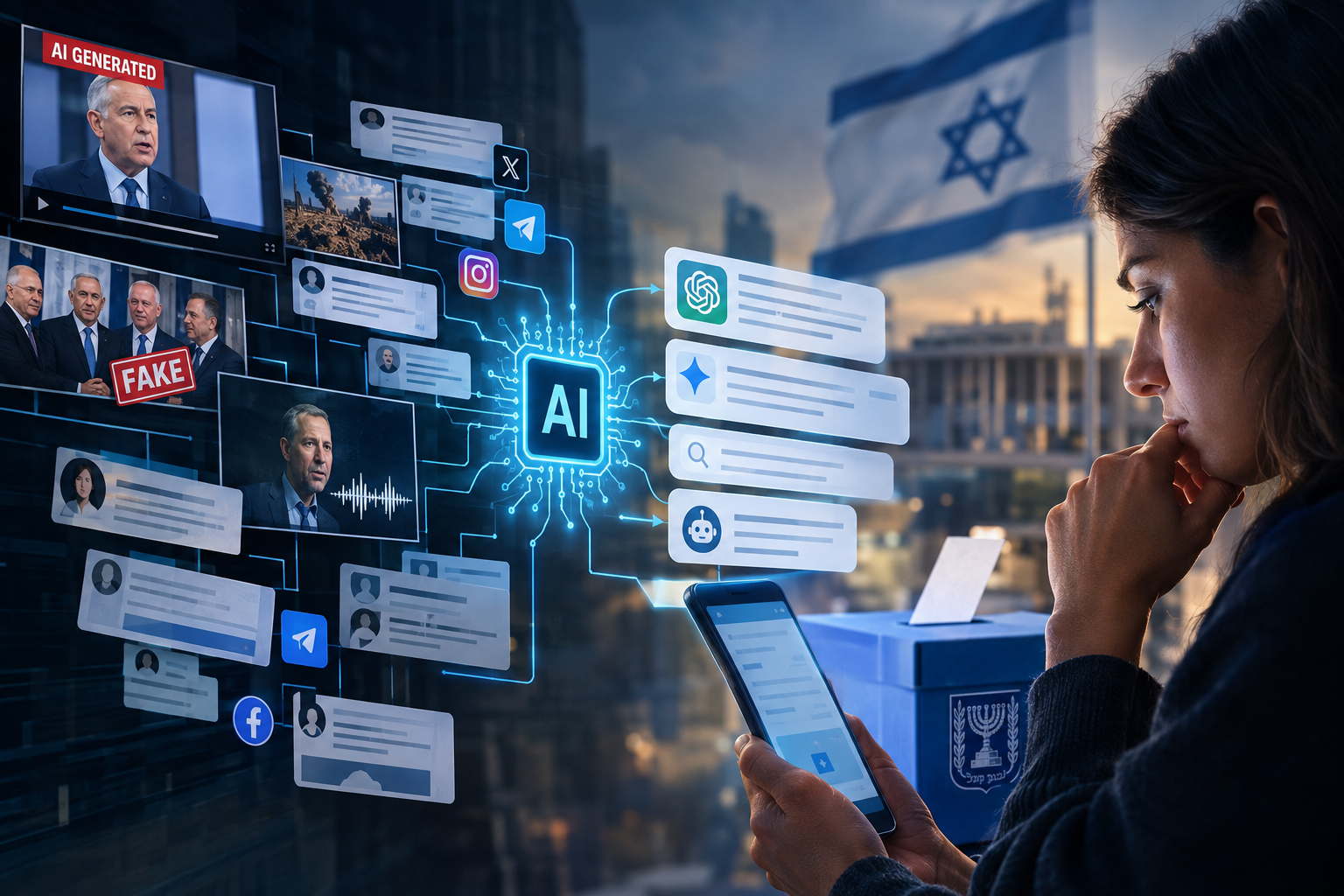
Israel's October 2026 election will be the first where generative AI can manufacture, clone, scale, personalize, and mediate political content. Here is what every voter should understand before heading to the ballot.

Israel has held many elections. It has also been a target.
In February 2020, Meta exposed a network of fake accounts operated from Tehran that impersonated Israeli protest movements. The operation, dubbed "Black Flags IL," ran across Facebook, Instagram, WhatsApp, Twitter, and Telegram using stolen photos and fabricated Hebrew-speaking identities. The operators gave themselves away through broken Hebrew, backward question marks from Persian keyboards, and phone interfaces showing a 1.5-hour time zone offset from Israel.
That was not an isolated case. Between 2020 and 2022, researchers at Israel's Institute for National Security Studies (INSS) documented at least four distinct Iranian influence operations targeting Israeli voters: infiltrating protest groups, targeting the ultra-Orthodox community with culturally tailored right-wing content, making personal contact with political activists through WhatsApp, and running coordinated voter suppression campaigns on election day itself. Before the November 2022 election, 40 fake Twitter accounts were created on a single day using stolen photos to push a hashtag designed to split the Religious Zionism alliance. After the election, a network of over 1,000 fictitious accounts spread claims of fraud and called for protests.
Iran is not the only actor, and elections are not the only target. But the documented pattern is clear: foreign operations against Israeli democracy are real, repeated, and increasingly sophisticated.
In September 2026, Golden Owl, an AI-powered open-source intelligence platform, published findings from a month-long investigation of the current campaign. They analyzed 21,533 posts, identified 57 accounts tied to a foreign influence operation, and mapped 32 fake personas, 81% of which were created in 2025-2026. One account used AI-generated profile images alongside photos stolen from an adult-film performer; its most-viewed post, calling for mass emigration from Israel, reached 688,434 views. Another account posted exclusively in Persian until April 2026, then rebranded with a Hebrew name nine weeks before the election.
The investigation also uncovered dark-web sellers offering Telegram accounts registered to Israeli phone numbers, databases containing Facebook profiles of four million Israelis, and voter data from the 2020-2021 election cycles on sale.
None of this required generative AI. Now imagine all of it with generative AI.
The October 27, 2026 election is Israel's first national election conducted in the age of generative AI. That does not mean previous elections were free of manipulation. Bots, troll farms, and doctored images have been part of campaigns for years. What has changed is the barrier to entry: the tools are available at unprecedentedly low cost and with little technical expertise.
This article does not tell anyone how to vote. It maps the new terrain so that voters, journalists, and campaign watchers can recognize what they are seeing.
Six Threats, One Pipeline
The threats generative AI introduces to an election are best understood as stages in a pipeline. Each stage builds on the one before it.
Create the event that never happened. Clone a real person's face and voice to narrate it. Scale it to millions of screens within hours. Personalize the framing so each audience hears what moves them most. Mediate the information flow so voters receive it through AI intermediaries they trust. Undermine trust so that even real evidence becomes deniable.
1. Create: Invent the Event
Generative AI can produce text, images, audio, and video that never existed. A fabricated clip of a politician making a statement they never made. A fake news article on a site designed to look like a credible outlet. Audio of a party leader allegedly recorded in a private conversation.
The quality of these outputs has crossed a threshold. Israel has already seen this in the current campaign. In January 2026, the Central Elections Committee ordered Likud to remove a manipulated image that appeared to show Naftali Bennett and Yair Lapid alongside Arab party leaders in a political gathering that never took place. The committee, chaired by Supreme Court Justice Noam Sohlberg, found that the image could mislead viewers into believing the depicted event was real.
Israel has introduced a temporary disclosure framework for certain AI-generated or digitally altered election propaganda for the 26th Knesset. The provision requires prominent disclosure for campaign content in which a person, place, event, or document has been digitally created or materially altered in a way that could make it appear authentic. A disclosure label can tell voters that content has been manipulated. It cannot, by itself, establish whether the underlying claim is true.
2. Clone: Put Someone Else's Voice on It
Voice cloning technology can now reproduce a person's voice from a short sample of recorded speech. Combined with video generation, it becomes possible to create convincing footage of public figures saying things they never said.
In the Israeli context, where political discourse often happens through leaked audio, informal recordings, and WhatsApp forwards, cloned content can exploit existing habits of information consumption. A cloned "leaked recording" of a coalition negotiation does not need to be perfect. It needs to be plausible enough to circulate for a few hours before it is debunked.
3. Scale: Make Millions of People See It
A single piece of fabricated content is a problem. An automated network distributing thousands of variations of it is a different kind of problem.
Generative AI enables what researchers call "content flooding," where synthetic accounts produce high volumes of posts, comments, and shares designed to create the illusion of grassroots support or opposition. What once required a room full of operators can now be run by a small team with access to the same large language models available to everyone.
Israel's State Comptroller reached a similar conclusion from a different direction. A July 2026 report found significant deficiencies in Israel's national preparedness for foreign influence in the digital environment. The report warned that AI allows hostile actors to create and distribute fabricated identities and content with greater credibility, at enormous scale and at high speed. The audit, conducted between July 2024 and January 2026, found that nine years after the threat was first identified, there is still no national policy and no government body leading a coordinated effort to address it.
4. Personalize: Tailor the Message to the Voter
This is where generative AI changes the game most fundamentally. Traditional propaganda is one message to many people. AI-driven campaigns can craft different messages for different audiences, adjusting tone, emphasis, and framing based on demographic, geographic, and behavioral data.
The same political objective can be framed as economic security for one voter, national security for another, and social stability for a third. The voter has no way to know that the message was crafted specifically for them, or that their neighbor received a contradicting message from the same source.
A survey commissioned by the Israeli Internet Association and conducted by Geocartography Group among 1,005 representative Israeli adults found that 25% are positively considering or intend to use AI tools to help make a voting decision. The same survey found that 71% of respondents have encountered false election-related information frequently or occasionally, cutting across all political affiliations.
The State Comptroller's report identified certain populations as particularly vulnerable: ultra-Orthodox, Arabic-speaking, Russian-speaking, and elderly communities. Personalized AI content targeting these communities in their language and cultural context is not a theoretical concern. The documented Iranian ADUK operation already targeted the Haredi community specifically with culturally tailored content in 2020-2021, before generative AI made such targeting trivially easy.
5. Mediate: Become the Information Layer
There is a less visible shift happening alongside the visible threats, and it may be the most significant one.
The deepfake is the obvious problem. The AI intermediary is the deeper one.
With a deepfake, you need to convince a person to believe a lie. With an AI intermediary, the person is asking the system to filter reality on their behalf. That is a fundamentally different dynamic.
AI chatbots are becoming an information channel for political decisions. A quarter of Israeli voters say they may ask an AI system which party aligns with their values. This turns chatbot design, training data, and retrieval mechanisms into factors that shape political outcomes, whether or not anyone intended that.
The information flow has changed structurally. A voter who once searched for news sources and read them directly now asks an AI system, which searches sources on their behalf, interprets the results, and delivers a synthesized answer. The AI sits between the voter and the information ecosystem. That is not a flaw in the technology. It is the architecture.
Chatoptic, an Israeli research firm, tested five leading chatbots (ChatGPT, Claude, Perplexity, Grok, and Gemini) using 26 detailed personas representing Israeli society. Across the simulation, they extracted 7,051 citations from 618 unique domains. Of those citations, 84% came from news outlets and publications. That means the models' political answers were heavily dependent on the existing media ecosystem.
The simulation also found substantial differences between models when identical voter personas were used. ChatGPT and Perplexity suggested completely different parties for the same voter profile, largely based on whether they used static training data or real-time search. Free versions of ChatGPT recommended "Bennett 2026," a party that is no longer on the ballot. The researchers caution that this was a single simulation based on specific personas, prompts, model versions, and timing, not a representative survey of voter behavior.
The result does not require a chatbot to have a consistent political bias. AI chatbots do not independently understand political reality. Their answers are shaped by their training data, retrieval systems, system instructions, model behavior, and the information available at the time. Different architectures can produce different political realities. Most users do not understand these mechanics and cannot evaluate them.
6. Undermine Trust: The Liar's Dividend
The greatest danger may not be that people believe fake evidence. It may be that they stop believing real evidence.
Researchers call this the "Liar's Dividend": the benefit that liars gain when the public is aware that synthetic content exists. A politician caught on a genuine recording can simply claim it was generated by AI. A real photograph of a real event can be waved away as a deepfake. The same technology that enables fabrication also provides a built-in excuse for anyone confronted with inconvenient truths.
The asymmetry is structural. Creating a convincing fake takes minutes. Debunking it takes hours or days. And the rebuttal rarely reaches everyone who saw the original. In the compressed timeline of an election campaign, especially in the final days before a vote, this asymmetry becomes acute. Content released late enough cannot be verified before polls open.
There is another problem: authentic content can be placed in a false context. An old photograph can be presented as a new event. A real recording can be selectively edited. A genuine statement can be translated or summarized in a way that changes its meaning. AI does not have to fabricate the underlying material to distort what people believe about it.
One Attack, Six Stages
Here is what a single operation could look like using all six stages together.
A foreign operator generates a synthetic video of a party leader making inflammatory statements at a private event that never occurred. AI clones the leader's voice from public speeches and maps their face onto the footage. Automated accounts distribute thousands of variations across social media, each version tweaked for different communities: the Russian-speaking version emphasizes one angle, the Arabic version another, the Hebrew version a third. The content gains enough traction that AI chatbots begin surfacing it in response to voter queries about the candidate. When the campaign issues a denial, supporters of the opposing side dismiss it: "Of course they would say it is fake. Everyone claims deepfake now."
From fabrication to deniability of truth, in under 48 hours.
Every component of this scenario is based on technology that already exists. What is new is that all six stages can now be executed by a small team at low cost, faster than any verification system can respond.
The Missing Framework
Here is the part that should concern every voter regardless of political affiliation.
Israel has no permanent legislation addressing foreign interference in the digital space. The State Comptroller's July 2026 report made this explicit: nine years after the threat was first identified, there is no national policy, no lead agency, and no coordinated government response. A national action plan was presented to the prime minister approximately a year before the election and remains unreviewed.
The Israeli Democracy Institute's Dr. Tahila Schwartz Altshuler identified a critical structural gap: there is no single body responsible for addressing foreign interference in Israel's digital space. Responsibility is fragmented across the Shabak, the National Cyber Authority, and the Central Elections Committee, with no clear mandate for any of them.
The Central Elections Committee's temporary disclosure framework for AI-generated content is a step. But it is temporary by design, limited to campaign materials, and does not address the broader ecosystem of foreign-operated fake accounts, AI-powered disinformation, or the chatbot mediation problem.
The State Comptroller recommended examining "soft regulation" models such as the EU's Digital Services Act, mandating disinformation and critical thinking curricula in schools, and renewing direct dialogue with social media platforms. Israel's last formal guidelines for content removal were updated in 2019. The report noted "significant difficulties" with platforms like Telegram that do not voluntarily cooperate.
Israel needs permanent legislation that assigns clear responsibility for monitoring and countering foreign digital interference, mandates transparency from platforms operating in the Israeli market, and establishes accountability mechanisms that survive beyond a single election cycle. Other democracies are building these frameworks. Israel, despite being a documented and repeated target, has not.
What Voters Can Do
When institutional safeguards are incomplete, voters become the last line of defense. That is not how it should work. But it is where we are.
Verify before sharing. If a video, recording, or screenshot triggers a strong emotional reaction, that is precisely when to pause. Check whether credible news sources have reported it. If not, do not forward it.
Check the source. Who published this? When? Is the account real? Does the website have a history of reporting, or did it appear last week? The Golden Owl investigation found fake personas that had been building credibility for over a year before activating for the current campaign.
Recognize emotional manipulation. Content that arrives via WhatsApp forward with no clear source, content that is "too perfect" in confirming what a specific audience wants to hear, content released in the final days before an election when there is no time to verify: these are warning signs, not certainties, but reasons for caution.
Do not treat AI as an oracle. AI chatbots do not independently understand political reality. Their answers are shaped by training data, retrieval systems, and the information available at the time. They are tools for exploration, not authorities on political decisions.
Demand transparency. Campaign organizations, social media platforms, and AI developers all have responsibilities. Voters can hold them accountable by asking direct questions: is this content generated? Is this account real? What are the labeling policies?
The Bigger Picture
The documented history is clear. Foreign actors have been running influence operations against Israeli elections since at least 2019, targeting protest movements, religious communities, Arab voters, and the general public. These operations have grown more sophisticated with each election cycle.
The Israeli context has specific features that amplify the risk: a fragmented media landscape, high WhatsApp usage as a primary news channel, a compressed campaign period, vulnerable populations with lower digital literacy, and a government that, by its own comptroller's assessment, has no coordinated policy to address the threat.
But the deeper shift is not about deepfakes. Generative AI is not just a tool for creating fake content. It is becoming part of the infrastructure through which voters construct political reality: from the content they see, to the identities that share it, to the AI systems that interpret it for them.
The first Israeli election of the generative AI era does not mean everything voters see will be fake. It means authenticity can no longer be assumed from appearance alone.
The technology can manufacture certainty. The voter still has the ability to question it.
Related Reading
- The White House Renamed AI. Your Keyword Filters Just Broke.
- Emergence World: Five AI Models Built Societies. Only One Survived Intact.
Sources
-
Institute for National Security Studies (INSS), "Foreign Interference and Iranian Influence on Social Networks in Israel," 2022. inss.org.il/publication/iranian-influence↗
-
Institute for National Security Studies (INSS), "Cyber and Elections in Israel," 2022. inss.org.il/he/publication/cyber-and-elections↗
-
Israel Democracy Institute, Dr. Tahila Schwartz Altshuler, "Foreign Interference in Israel's Digital Space," 2026. idi.org.il/articles/65255↗
-
Israel Democracy Institute, "Central Elections Committee Orders Removal of Manipulated Image," 2026. en.idi.org.il/articles/63316↗
-
State Comptroller of Israel, "Foreign Influence in the Digital Environment" (FIMI Report), July 2026. Summarized by the Israeli Internet Association: isoc.org.il/regulation-digital-services/state-comptrollers-report-fimi-2026↗
-
Times of Israel, "State Comptroller: Government Has No Policy to Combat Foreign Election Meddling," 2026. timesofisrael.com↗
-
Jerusalem Post, "Golden Owl Investigation: Iran-Linked Accounts Target Israeli Election," September 2026. jpost.com/israel-election-2026/article-909863↗
-
Chatoptic, "Israel 2026 Elections: AI Visibility Simulation (EAVI)," 2026. chatoptic.com/blog/israel-2026-elections-ai-visibility-simulation↗
-
Israeli Internet Association and Geocartography Group, Survey on Disinformation and AI in Israeli Elections, 2026.
-
Middle East Institute, "Iran Targeted Israel's April 2019 Elections: Was It Preparing for US 2020 Elections?" 2019. mei.edu/publications/iran-targeted-israels-april-2019-elections↗
-
Tachlith Institute, "Social Media and Elections in Israel," 2026. tachlith.org.il/socialmedia-elections↗
Discussion
No comments yet. Be the first to start the discussion.
Related Articles
The AI Dictionary: Every Term You Need to Know, Explained Simply
A plain-language glossary of AI terms from the absolute basics to advanced concepts. No jargon walls, no assumptions. Every term explained so anyone can understand it.
AIJev and the Rise of Decision Models: What Changes When AI Returns Probabilities Instead of Text
TypeSafe AI's Jev returns typed decisions with probabilities instead of text. A technical look at what is new in the approach, a fair comparison with structured-output LLMs, what independent research says about calibration, and what it takes to self-host Jev-class open models.
AILLVM Is the Invisible Engine Behind AI Hardware. Here Is How.
From GPUs to custom AI chips, every major hardware company depends on LLVM and its younger sibling MLIR to turn AI models into running code. Here is what they are and why they matter.
Stay in the loop
Get new articles on infrastructure and AI delivered to your inbox. No spam, unsubscribe anytime.