Two Ways to Win an AI Race: Own the Model, or Spread It
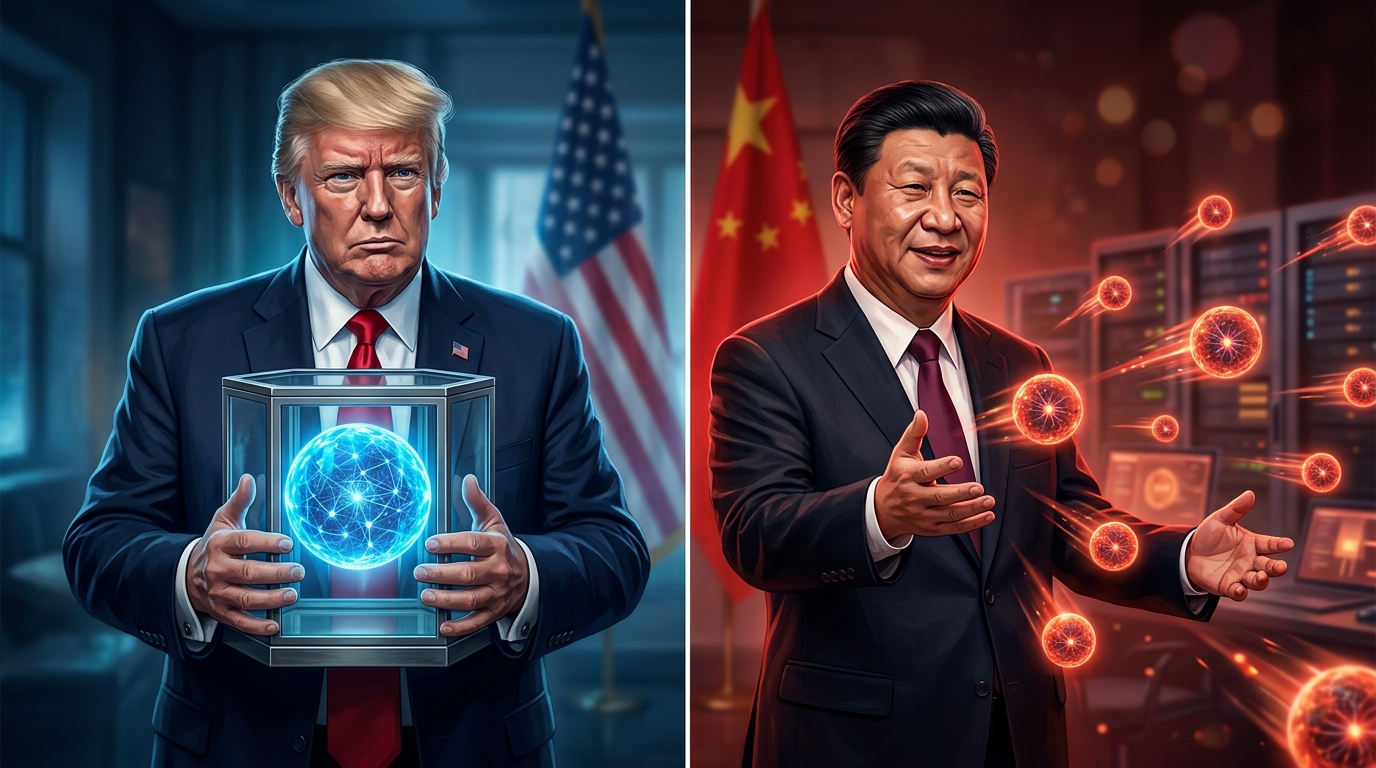
The US optimizes for owning its best frontier models. Several Chinese labs release near-frontier weights instead. Two different bets about turning AI capability into power, and it is not yet clear which one wins.

When I build a shortlist of frontier and near-frontier models for a private, on-premises deployment, a pattern shows up that is worth stating carefully. Most of the strongest models whose weights I can actually download and run inside the building come from Chinese labs: DeepSeek, Moonshot, Z.ai, and parts of Alibaba's Qwen family. The models that usually sit at the very top of the capability leaderboards, Anthropic's Claude and OpenAI's GPT, I can use but not hold. I reach them through an API.
That is a narrow, factual observation, and it is easy to inflate into something it is not. So let me keep it honest. This is not "America closed, China open." That framing is wrong, and I want to walk through why, and then say what the real difference is.
The words first
People use "open-weight" and "open source" as if they mean the same thing. They do not, and the gap changes what you can actually do with a model.
A finished model is the result of a recipe. There is the data it was trained on, the code and method used to train it, and the weights, which are the numbers the training produces and the part you actually run.
Open-weight means you get the result only. You can download the trained model and run it yourself, but you do not necessarily get the data it learned from or the method used to build it, and the license often restricts use. It is like being handed a finished cake. You can eat it and serve it, but you cannot see the full ingredient list or reliably reproduce it.
Open-source AI is a much stronger claim. In the sense the Open Source Initiative now defines it, it means the pieces needed to study, modify, and reproduce the system are released under terms that do not restrict who may use them: the weights, enough information about the training data to recreate it, and the code. That is like getting the cake plus the recipe and the ingredient list, so you can bake it again and change it.
Almost no frontier model, from either country, meets that bar. DeepSeek, GLM, and Qwen release their weights but not their training data or full method, so they are open-weight, not open source. The clearest example of a genuinely open release is a research model, the Allen Institute's OLMo, which publishes its weights, its full training data, and its code together (Allen Institute↗). It is not a frontier model, and that is the point: full openness and top capability almost never arrive in the same package. So when you read that a Chinese lab "open-sourced" a model, read "open-weight."
America is not closed. Its frontier is.
The United States releases open-weight models constantly. OpenAI put out gpt-oss under Apache 2.0 in August 2025 (OpenAI↗). Google moved Gemma to Apache 2.0. Nvidia's Nemotron family ships weights, data, and training recipes, because open models drive demand for its GPUs. Meta built its reputation on open Llama releases, though it has pulled in both directions since. Anyone who says America does not do open weights is not looking.
The precise statement is narrower. Among the major US frontier labs, the highest-capability proprietary models have generally stayed closed, even as open-weight releases expanded below and alongside the frontier. gpt-oss is a capable open model, but it is not GPT.
The reasons the top tier stays closed include safety, security, competitive differentiation, and economics, and I will not pretend to know their relative weight. The commercial logic, though, is straightforward: a closed frontier model can be turned into metered revenue through API access, subscriptions, and cloud partnerships. Releasing the weights changes that economics at the root. Anthropic, for its part, treats protecting model weights as a security requirement under its highest safety framework (Anthropic, May 2025↗). That does not by itself explain the business choice to keep frontier weights closed, but it shows one real cost of releasing them.
China's frontier labs release more of their best work. Not all of it.
The real difference is at the top. Several Chinese labs have released weights for models that, by current benchmarks and independent evaluations, sit close enough to the frontier to belong in the same conversation as the leading proprietary models. DeepSeek, Kimi, and GLM were downloadable within months of launch. That is the genuine contrast: the strongest open-weight models available today are mostly Chinese, while the strongest models overall are mostly closed and American.
But "China open" is also too clean. Alibaba kept its top Qwen-Max tiers proprietary before partly reopening them, and ByteDance's flagship consumer models are closed. More pointedly, Beijing spent part of 2026 reportedly weighing restrictions on overseas access to its most advanced models, after meetings with Alibaba, ByteDance, and Z.ai (Reuters, via TIME, July 2026↗). Openness a government might switch off is a tactic, not a principle.
And there is no public evidence that Beijing orders any of this. The claim that China runs a single "open-weight strategy" is an inference analysts draw from broad policy documents, not a directive the Chinese government has stated. A plainer reading fits: for labs competing just behind the top US models, releasing weights is a way to turn technical capability into developer adoption and ecosystem position without having to win the commercial frontier outright. That is rational behavior by the labs. Attribute it to them, not to a central plan.
What releasing actually buys, and what it does not
The adoption is real and measurable. Hugging Face counted more than 150,000 Qwen-derived models on its platform, the largest such ecosystem of any open model family (Hugging Face, August 2026↗). That is evidence of ecosystem activity, not proof of commercial or geopolitical dominance. On OpenRouter, a developer gateway, Chinese open models rose from about 1.2% of traffic in late 2024 to a peak near 30% a year later (a16z, December 2025↗), which measures that platform's developers, not global usage.
Now the part that deflates the loudest version of the story. Open weights create distribution, but not an automatic feedback loop for the company that released them. CSIS states it directly: when a model "is downloaded from a U.S. cloud provider, run through a third-party inference platform, or deployed locally inside a company, the original Chinese developer cannot see the prompts, logs, feedback, tool calls, or product behavior," and concludes that "monetization is highly difficult with the open-weight strategy" (CSIS, July 2026↗). Once a customer runs the model locally, the usage stays with the customer. DeepSeek still earns the ordinary way, through a paid API, and it has been raising prices, not racing them to zero.
Adoption is also not the same as leading. On Stanford's composite index, US models kept a measurable lead in early 2026, roughly 2.7 points, though the gap had narrowed sharply from the year before, and American private AI investment ran far ahead at $285.9 billion against China's $12.4 billion (Stanford HAI AI Index 2026↗).
Open weights also carry a risk proprietary APIs can contain more easily. Once weights are distributed, the developer cannot recall them or push a later safety update centrally. US government testing illustrated the downside: it found DeepSeek's model followed malicious agent-hijacking instructions far more often than American reference models and answered the large majority of jailbreak attempts (NIST CAISI, September 2025↗). That is a property of releasing weights, not a verdict on one lab.
Two bets, not two teams
Here is the comparison without the hype. Both countries have frontier labs that are close in capability. They are making different bets about what to do with a frontier model once they have one.
The American bet is to own the best model and sell access to it: keep the top weights inside, monetize through APIs and cloud, and let the tier below go open for reach and goodwill. It monetizes control. The ceiling is reach, because a closed model is harder to embed where it has to run on someone else's hardware.
The Chinese bet, at least from the labs still just behind the frontier, is to release near-frontier weights and become the base layer other people build on. It monetizes, or at least accumulates, something different: reach. The weaknesses are that it earns less directly, it hands out a gift with no feedback loop, and it depends on a tolerance from Beijing that may not hold.
For an enterprise running AI privately, that distinction is not abstract. A model you can download changes the architecture around it. You decide where it runs, what data it sees, how it is integrated, and which infrastructure carries the load. That turns a question about model openness into a question about technological dependence, which is where the geopolitics stops being someone else's problem. And it is also why, if capable models keep getting cheaper to obtain, the durable value moves off the model and into the layers around it: the compute and interconnect, the inference stack that makes a model affordable in production, and the integration work that turns a set of weights into something a business actually runs.
The smartest model may win the benchmark. The most widely deployed model may win something else. The honest part is that we do not yet know whether control or reach converts into the other, or which one matters more in the end. That unresolved question, not a winner, is the actual state of the race.
Related Reading
- Anthropic's S-1: The Real Cost of Building Frontier AI
- The Open Frontier Changed While You Were Planning Your K3 Deployment
- Kimi K3: The First Open Frontier Model You Can Actually Run On-Prem (Architecture, TCO, and VCF PAI Deployment)
References
- Allen Institute for AI, Hello OLMo: A truly open LLM↗
- OpenAI, Introducing gpt-oss (August 2025)↗
- Anthropic, Activating ASL-3 Protections (May 2025)↗
- Hugging Face, State of Open Models Summer 2026 (August 2026)↗
- a16z, State of AI (December 2025)↗
- CSIS, What to Know About Chinese AI Models (July 2026)↗
- Stanford HAI, 2026 AI Index Report↗
- NIST CAISI, Evaluation of DeepSeek AI Models (September 2025)↗
- Reuters, China weighs curbing overseas access to top AI models, via TIME (July 2026)↗
Discussion
No comments yet. Be the first to start the discussion.
Related Articles
The AI Dictionary: Every Term You Need to Know, Explained Simply
A plain-language glossary of AI terms from the absolute basics to advanced concepts. No jargon walls, no assumptions. Every term explained so anyone can understand it.
AIJev and the Rise of Decision Models: What Changes When AI Returns Probabilities Instead of Text
TypeSafe AI's Jev returns typed decisions with probabilities instead of text. A technical look at what is new in the approach, a fair comparison with structured-output LLMs, what independent research says about calibration, and what it takes to self-host Jev-class open models.
AILLVM Is the Invisible Engine Behind AI Hardware. Here Is How.
From GPUs to custom AI chips, every major hardware company depends on LLVM and its younger sibling MLIR to turn AI models into running code. Here is what they are and why they matter.
Stay in the loop
Get new articles on infrastructure and AI delivered to your inbox. No spam, unsubscribe anytime.