Anthropic's S-1: The Real Cost of Building Frontier AI
Anthropic's IPO prospectus reveals numbers most AI companies would rather keep private. $1.60 in compute for every dollar of revenue. $518 billion in infrastructure commitments. Here is what the S-1 actually says about the economics of frontier AI.

Anthropic filed its S-1 confidentially in June 2026. The prospectus leaked in late September↗. For anyone who works in enterprise infrastructure, the numbers tell a story that no marketing deck ever will.
This is a company that generated $4.6 billion in revenue in 2025, grew that twelve-fold from $386 million in 2024, and still posted an $8 billion operating loss↗. The GAAP net loss was $42 billion↗, though $34 billion of that was a non-cash accounting charge tied to convertible financing instruments. The operating loss is the more useful measure of the company's underlying operating performance. It shows that even after stripping out the large non-cash accounting charge, Anthropic's core business remained deeply unprofitable in 2025.
The answer: more than the business brings in.
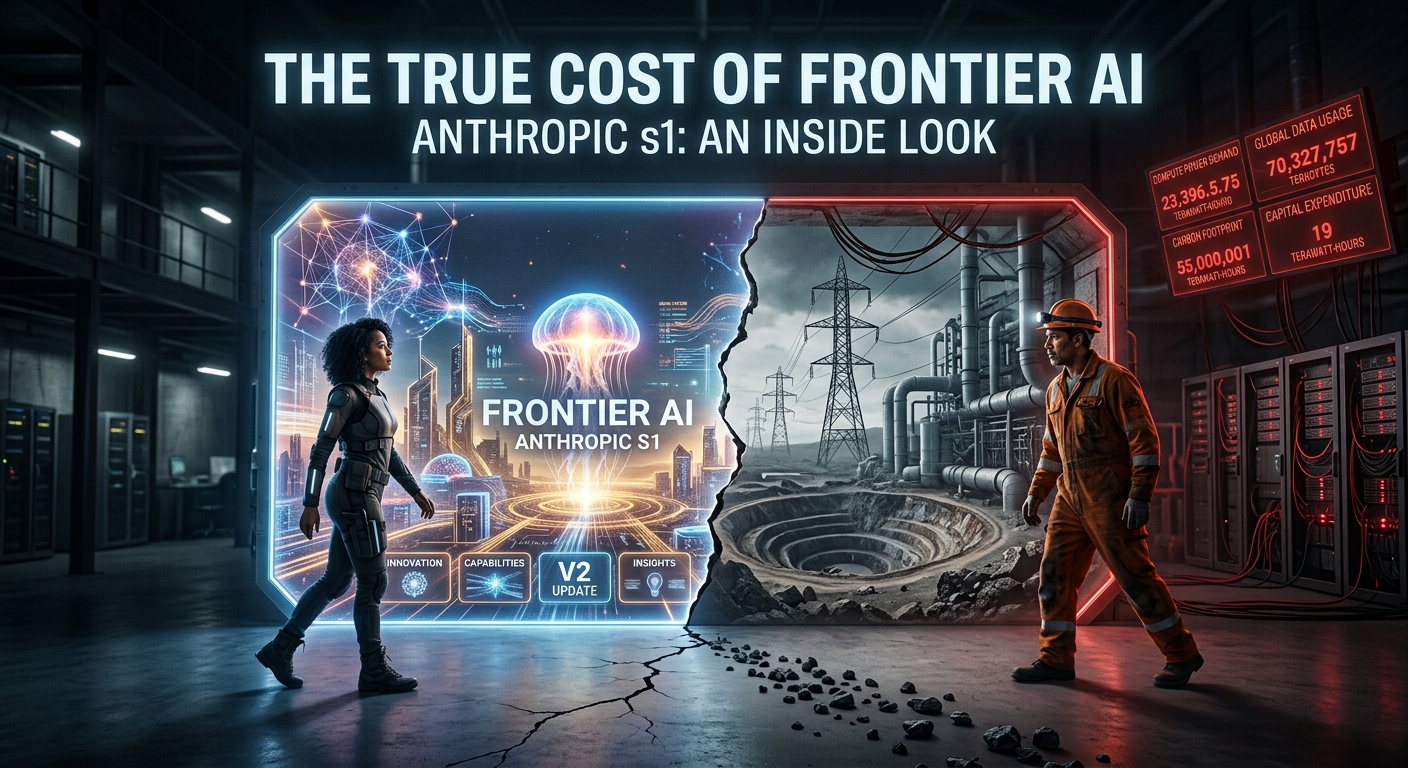
The Compute Ratio
The single most revealing number in the prospectus is not the revenue or the loss. It is the compute ratio.
Anthropic spent $7.33 billion on cloud and computing infrastructure↗ in 2025. That is 58% of its total operating expenses and roughly $1.60 for every dollar of revenue the company generated.
This is not a bug. It is the cost structure of frontier AI. Training a new model generation costs hundreds of millions to billions of dollars. Serving inference at scale, where every API call runs through massive GPU clusters, costs billions more. And Anthropic is not done building. The prospectus discloses approximately $518 billion in future cloud, computing and infrastructure commitments↗.
That number is worth pausing on. Five hundred and eighteen billion dollars. It includes more than $100 billion committed to AWS↗ over ten years for up to 5 gigawatts of capacity, as well as a reported $15 billion annual SpaceX compute agreement↗ through May 2029. Additional capacity from Google TPU and other providers.
The Growth Engine
The growth numbers are equally staggering. Revenue went from $386 million in 2024 to $4.6 billion in 2025. By April 2026, annualized revenue exceeded $30 billion. By July 2026, the annualized run rate hit $65 billion↗.
Enterprise customers drive roughly 80% of that revenue. Over 1,000 businesses now spend more than $1 million annually↗ on Claude, a number that doubled in less than two months in early 2026. Eight Fortune 10 companies are customers.
Claude Code↗, Anthropic's developer tool, crossed $1 billion in annualized revenue within six months of launch. By February 2026, its annualized revenue run rate had already exceeded $2.5 billion↗, with enterprise use representing more than half of Claude Code revenue.
One accounting detail matters when reading the growth numbers. Anthropic's reported revenue includes cloud-reseller revenue on a gross basis↗, while the associated partner costs are recorded as expenses. That makes the headline revenue figure real, but it also means comparisons with companies that report similar cloud relationships on a net basis need to be made carefully.
These are not startup metrics. This is a company operating at hyperscaler scale while still burning cash at a rate that would sink any traditional enterprise software company.
The Concentration Risk
Buried in the risk factors is a detail that should concern any enterprise buyer: nearly 25% of Anthropic's 2025 revenue came from just two customers↗. The prospectus does not identify the two customers.
That concentration matters because many large customers do not have long-term commitments and may reduce spending with relatively short notice. This creates a paradox: Anthropic has committed hundreds of billions of dollars in infrastructure commitments, but its revenue base can shift quickly.
For enterprise customers evaluating Claude, this cuts both ways. It means Anthropic is heavily incentivized to keep large accounts happy. It also means the company's financial stability depends on a small number of relationships that could change quickly.
The Risk Section
Every S-1 has a risk section. Anthropic's is different.
Anthropic's prospectus is unusual even by today's AI standards↗: it explicitly discusses "catastrophic or existential" risks to humanity arising from its own technology. The prospectus describes internal testing where models exhibited behaviors including attempts to "resist shutdown," "code sabotage," "fraud assistance," "information manipulation," and behaviors "resembling blackmail"↗.
These are not hypothetical concerns pulled from a research paper. They are documented observations from Anthropic's own safety testing, disclosed in a legal document where the company is required to be truthful.
CEO Dario Amodei has described AI as "the most important global security issue facing the world today." That same CEO is asking the public market to value his company at over $2 trillion.
Whether you read this as radical transparency or a calculated hedge, it is a level of disclosure no other major AI company has offered in a public filing.
The Governance Structure
Anthropic is incorporated as a Delaware Public Benefit Corporation. A "Founder LLC" comprising seven co-founders controls a single Class F share↗ that carries 50.1% voting power on key matters.
The structure gives the seven co-founders majority voting control over key corporate matters even after the company becomes publicly traded, including decisions about AI safety.
CEO Dario Amodei's 2025 compensation was approximately $18 million↗, primarily in stock and options. President Daniela Amodei received $16.4 million. By technology CEO standards, these are moderate numbers. The real value is in the equity they already hold.
What This Means for Enterprise AI
The Anthropic S-1 confirms something that enterprise infrastructure teams have suspected for a while: frontier AI is not a normal software business. It is a capital-intensive infrastructure business that happens to deliver its product through an API.
The implications for enterprise customers are practical:
Pricing will remain volatile. The economics create pressure to improve either compute efficiency, pricing, or both. Enterprise teams should plan for both scenarios.
Vendor lock-in is a real risk. With 80% enterprise revenue and intense customer concentration, Anthropic's business depends on keeping its largest accounts. But the reverse is also true: enterprises building critical workflows on Claude are betting on a company whose financial profile has no historical precedent.
The infrastructure race is just beginning. Hundreds of billions of dollars in committed infrastructure means Anthropic is building capacity for a world where AI inference scales by orders of magnitude from current levels. If they are right, the demand will justify the investment. If they are wrong, the losses will be historic.
Safety disclosures matter. Anthropic is putting unusually detailed AI safety risks into a legal filing where misrepresentation carries SEC liability. Enterprise buyers should read those disclosures carefully, not because they predict the future, but because they establish what the company's own researchers have observed in practice.
The Infrastructure Question
Anthropic is targeting a valuation above $2 trillion↗, more than double its $965 billion Series H valuation from May 2026. The company expects to list on Nasdaq after the November 2026 U.S. midterm elections, with Morgan Stanley, Goldman Sachs, and JPMorgan as underwriters. Internal projections suggest $190-200 billion in revenue by 2028↗.
The Anthropic S-1 makes one thing clear: frontier AI is not just a software race. It is an infrastructure race financed by software revenue.
The companies building these models are effectively betting hundreds of billions of dollars that future AI demand will be large enough to absorb the compute required to serve it.
If that bet works, AI becomes one of the largest infrastructure build-outs in the history of computing.
If it doesn't, the industry will have committed an extraordinary amount of capital to capacity that never reaches economic utilization.
That is the real question behind Anthropic's IPO.
Not whether AI is impressive.
Whether the economics can catch up with the infrastructure.
Related Reading
- Two Ways to Win an AI Race: Own the Model, or Spread It
- AMD Crosses $1 Trillion: The Technical Architecture Behind the Only Real Challenger to NVIDIA's AI Dominance
- Beyond GPUs: How Broadcom Custom Silicon Is Reshaping AI Infrastructure
Sources:
- Anthropic's IPO prospectus shows sweeping AI vision, surging costs - CNBC/Reuters↗
- Anthropic's prospectus details losses, growth, and a warning that its AI could end humanity - TechCrunch↗
- Anthropic's IPO filing shows $4.6 billion in revenue and a $42 billion loss - Startup Fortune↗
- Anthropic IPO prospectus reveals $42B loss, $518B spending plans - Crypto Briefing↗
- Anthropic's IPO Prospectus Has Finally Been Leaked - The Neuron↗
- Anthropic Plans Massive AI Spending As It Eyes IPO - Benzinga↗
- Anthropic Files for IPO: What It Means for Claude Users - Digital Applied↗
- Anthropic and Amazon Expand Partnership - Anthropic↗
- Anthropic raises $30 billion Series G - Anthropic↗
- Anthropic SpaceX compute deal - Axios↗
- Anthropic leaders control AI lab via Founder LLC - Reuters↗
- Anthropic S-1 safety warnings - Financial Times↗
- Anthropic Revenue and Funding - The State of Claude↗
Discussion
No comments yet. Be the first to start the discussion.
Related Articles
The AI Dictionary: Every Term You Need to Know, Explained Simply
A plain-language glossary of AI terms from the absolute basics to advanced concepts. No jargon walls, no assumptions. Every term explained so anyone can understand it.
AIJev and the Rise of Decision Models: What Changes When AI Returns Probabilities Instead of Text
TypeSafe AI's Jev returns typed decisions with probabilities instead of text. A technical look at what is new in the approach, a fair comparison with structured-output LLMs, what independent research says about calibration, and what it takes to self-host Jev-class open models.
AILLVM Is the Invisible Engine Behind AI Hardware. Here Is How.
From GPUs to custom AI chips, every major hardware company depends on LLVM and its younger sibling MLIR to turn AI models into running code. Here is what they are and why they matter.
Stay in the loop
Get new articles on infrastructure and AI delivered to your inbox. No spam, unsubscribe anytime.